
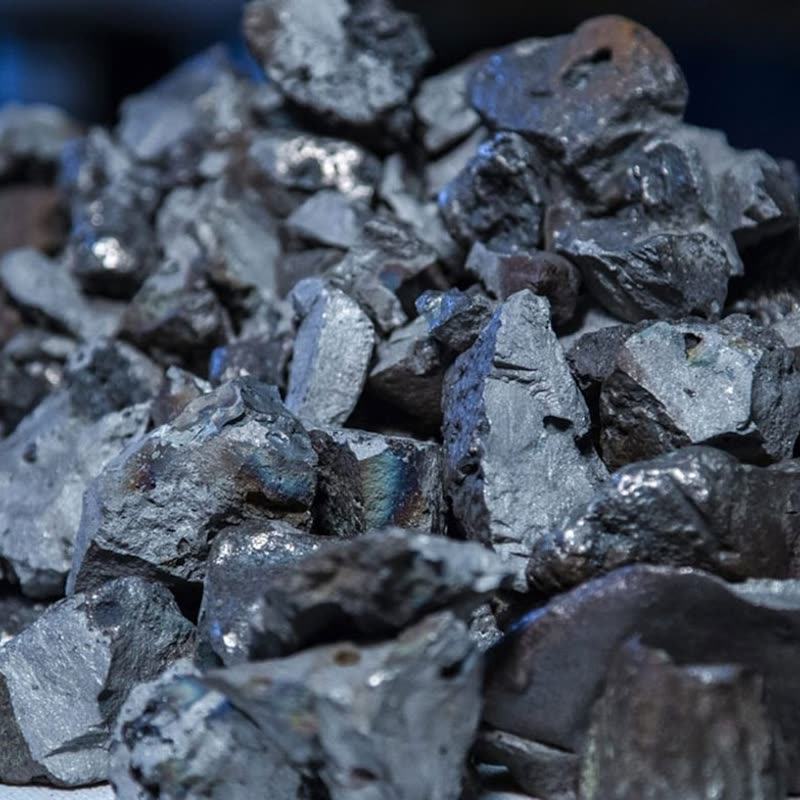
Nearly every tonne of steel made today passes through manganese. About 90% of the world’s manganese goes into steelmaking, and there is no good substitute for it. Strip it out and steel turns brittle and dirty. That is why ferromanganese, the alloy that carries manganese into the furnace, sits quietly behind almost everything built from steel, from car bodies to bridges to wind turbines.
This guide explains what ferromanganese is, how it is used and made, and why the way it is produced, not just the alloy itself, is becoming the thing buyers care about most.
What is ferromanganese?
Ferromanganese is an alloy of iron and manganese. Steelmakers add it to molten steel for two jobs. First, it strips out oxygen and sulphur, impurities that would otherwise leave the finished steel weak and prone to cracking. Second, the manganese that stays behind makes the steel harder and tougher. Most carbon steel contains somewhere between 0.3% and 2% manganese, and on average a tonne of steel takes about 10 kg of manganese to make.
The alloy comes in grades defined by their carbon content:
- High carbon ferro-manganese (HCFeMn) carries roughly 74 to 76% manganese with a high carbon content. It is the workhorse grade, the most widely used and the most cost-effective way to add manganese to bulk steel.
- Medium and low carbon ferro-manganese trade higher cost for lower carbon, and feed into specialty and high-grade steels where carbon has to be controlled tightly.
- Silico-manganese (SiMn) carries both manganese and silicon, so steelmakers can add the two elements in a single shot. It typically runs around 65 to 68% manganese and 16 to 20% silicon.
If you have searched for “ferromanganese uses” or “manganese alloy,” these grades are the answer to your question. The choice between them comes down to the steel grade being made and how much the mill is willing to pay to control carbon. (You can see the grades Sakura produces and their typical specifications on our products page.)
How ferromanganese is made
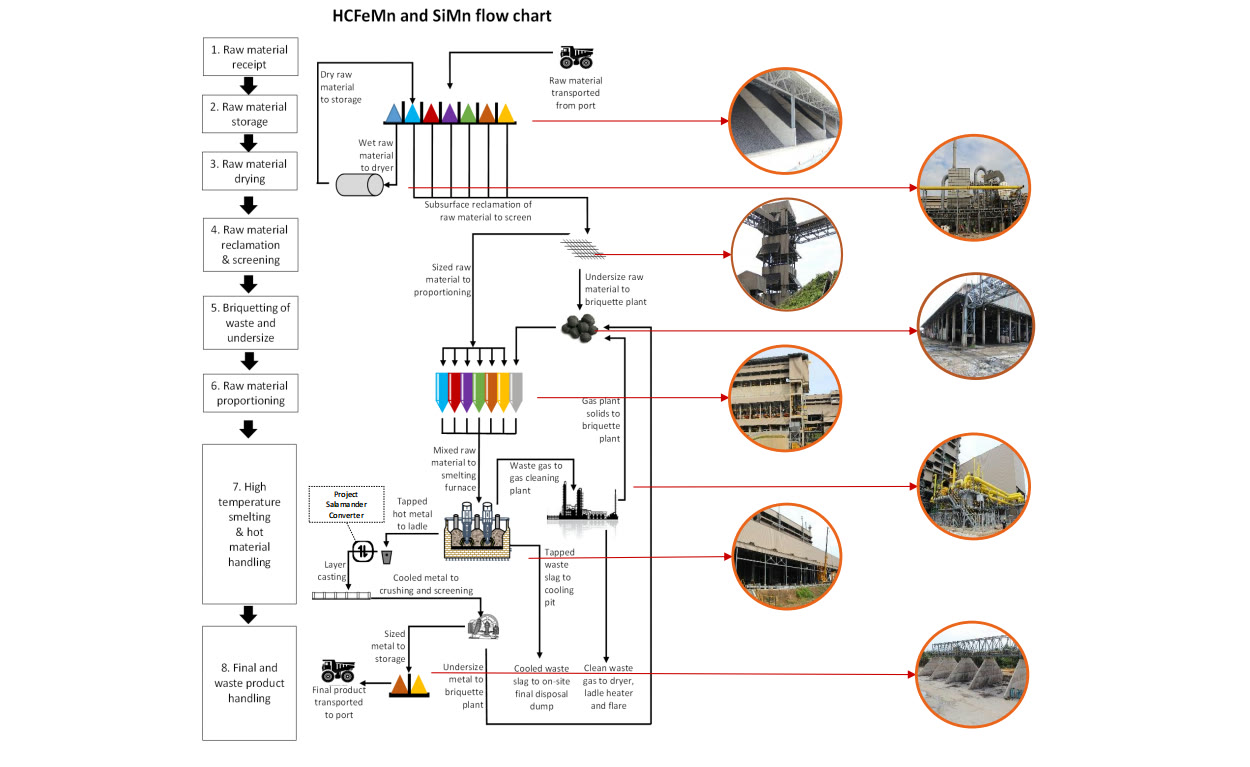
The production process is a controlled chain from raw ore to finished alloy. At Sakura Ferroalloys’ plant in Samalaju, Sarawak, it runs in eight stages:
- Raw material receipt. Manganese ore, coke and fluxes arrive from port.
- Storage and drying. Dry material goes to storage; wet material is dried first so moisture is under control before smelting.
- Reclamation and screening. Material is screened to size. Correctly sized ore goes forward; fines and undersize are routed to the briquette plant.
- Briquetting. Fines, filter cake and recovered dust are bound into extruded BREX briquettes and sent back to the furnace, so almost nothing is wasted.
- Proportioning. Sized ore and briquettes are weighed and blended to the exact recipe each grade needs.
- Smelting. The blend is reduced with coke in submerged-arc furnaces. Sakura runs two 81 MVA closed furnaces.
- Tapping and casting. Hot metal is tapped to ladle; waste gas goes to the gas-cleaning plant and slag to the cooling pit.
- Crushing, screening and shipping. The cooled alloy is sized to customer spec, stored, and shipped to port.
The chemistry is straightforward in principle. Manganese oxide in the ore is reduced by carbon from the coke at furnace temperature, leaving the iron-manganese alloy behind. The hard part is doing it efficiently, safely and cleanly at scale, which is where the energy source starts to matter.
The shift that is changing the market
Here is the part most product descriptions skip. A submerged-arc furnace is a giant electricity consumer. Smelting ferromanganese can draw on the order of 2,000 kWh per tonne, and the carbon footprint of that electricity ends up baked into the alloy. Two producers can ship chemically identical HCFeMn while one carries a fraction of the other’s emissions, purely because of how the power was generated.
For years that difference did not show up on an invoice. It does now.
The European Union’s Carbon Border Adjustment Mechanism (CBAM) puts a price on the carbon embedded in imported materials, including ferroalloys. A high-emission tonne of ferromanganese now carries a cost penalty at the EU border that a low-emission tonne avoids. Steelmakers chasing “green steel” targets are starting to pick suppliers on carbon intensity, not just price and chemistry. The market is splitting into verified low-carbon supply and everything else.
This is why “low carbon ferromanganese” has gone from a niche phrase to a commercial search term. Buyers are looking for it because their own customers, and their regulators, are asking for it.
Where Sakura fits
Sakura Ferroalloys was built around this idea before the regulations arrived. The plant was sited in Sarawak specifically for its renewable hydropower, so the electricity feeding those two 81 MVA furnaces is predominantly hydroelectric rather than coal-fired. That single decision, made at the start, is the foundation of a low-carbon footprint that is hard for fossil-powered competitors to match.
The numbers back it up. In its FY2025 reporting year, Sakura cut overall emissions volume by 8.4%, reduced energy consumption by 7.21%, and improved Scope 1 emissions intensity by 5% against the prior year. Its targets go further: a 30% reduction in stack emissions by 2030 and net zero by 2050, aligned with Malaysia’s national pledge and Sarawak’s Net Zero Carbon Strategy.
There is more coming. The Salamander Project, a USD 90 million refined-ferromanganese converter approved in 2025, will let Sakura produce refined, lower-carbon grades with a smaller footprint, aimed squarely at the specialty and high-grade steel markets that need them. Alongside it sit decarbonisation projects with names like Firefly, which is designed to convert furnace carbon monoxide into ethanol and sustainable aviation fuel, and Kuro, which replaces fossil reductants with bio-carbon.
Sakura is the largest seaborne exporter of high carbon ferro-manganese, supplying steel markets across the USA, Europe, Japan, Taiwan, India, Australia and the Middle East. The competitive edge is no longer just scale or reliability. It is producing a commodity alloy with a carbon story that holds up under scrutiny.
What this means if you buy ferromanganese
Three things are worth taking away.
The grade still matters. Match HCFeMn, low carbon ferro-manganese or SiMn to the steel you are making and the carbon spec you have to hit.
The producer matters more than it used to. Under CBAM and green-steel commitments, the embedded carbon of your alloy is now a cost and a compliance question, not just an environmental one. Ask suppliers for their energy source and emissions data, and treat a vague answer as a red flag.
And the direction of travel looks clear. As carbon pricing spreads beyond Europe, the premium for verified low-carbon ferroalloys is likely to widen rather than shrink. Producers powered by renewable energy today are positioned for the market that is arriving, not the one that is leaving.
If you want to talk specifications, supply or the carbon footprint of your manganese alloys, get in touch with our team.